

As a supplier of 220v To 380v VFDs 220v To 380v VFD, I often encounter customers who are confused about the error codes displayed on these variable frequency drives. In this blog post, I'll explain the meanings of some common error codes in 220v To 380v VFDs to help you troubleshoot and maintain your equipment effectively.
Over - Voltage Error (OV)
One of the most frequently seen error codes is the over - voltage error. When a 220v To 380v VFD shows an OV error, it indicates that the DC bus voltage inside the drive has exceeded the allowable limit. There are several reasons for this error.
Firstly, sudden deceleration can cause over - voltage. When the motor decelerates too quickly, it acts as a generator, feeding back electrical energy to the DC bus. If the drive's braking resistor or braking unit cannot dissipate this energy fast enough, the DC bus voltage will rise.
Secondly, an unstable power supply can also lead to over - voltage. If the input voltage from the 220V source fluctuates significantly and reaches a high level, the VFD will detect an over - voltage condition.
To solve this problem, you can adjust the deceleration time in the VFD settings to make it longer, allowing the motor to slow down more gradually. Additionally, check the power supply for stability and consider using a voltage stabilizer if necessary.
Under - Voltage Error (UV)
The under - voltage error (UV) means that the DC bus voltage has dropped below the specified minimum value. This error can be caused by a few factors.
A common cause is a power supply problem. If the input voltage from the 220V source is too low, the VFD will not be able to maintain the proper DC bus voltage. This could be due to a long power cable with high resistance, a faulty transformer, or a problem with the power grid.
Another reason is a malfunctioning rectifier circuit inside the VFD. The rectifier is responsible for converting the AC input voltage to DC voltage. If it fails, the DC bus voltage will drop.
To address the under - voltage issue, check the input voltage at the VFD terminals. If the voltage is low, you may need to shorten the power cable, replace the transformer, or contact the power utility to check the grid. If the rectifier is suspected to be faulty, it should be inspected and replaced by a professional technician.
Over - Current Error (OC)
An over - current error (OC) indicates that the current flowing through the VFD has exceeded its rated value. This is a serious error that can damage the VFD components if not addressed promptly.
One of the main causes of over - current is a short - circuit in the motor or the wiring. A short - circuit can cause a large amount of current to flow, triggering the over - current protection in the VFD.

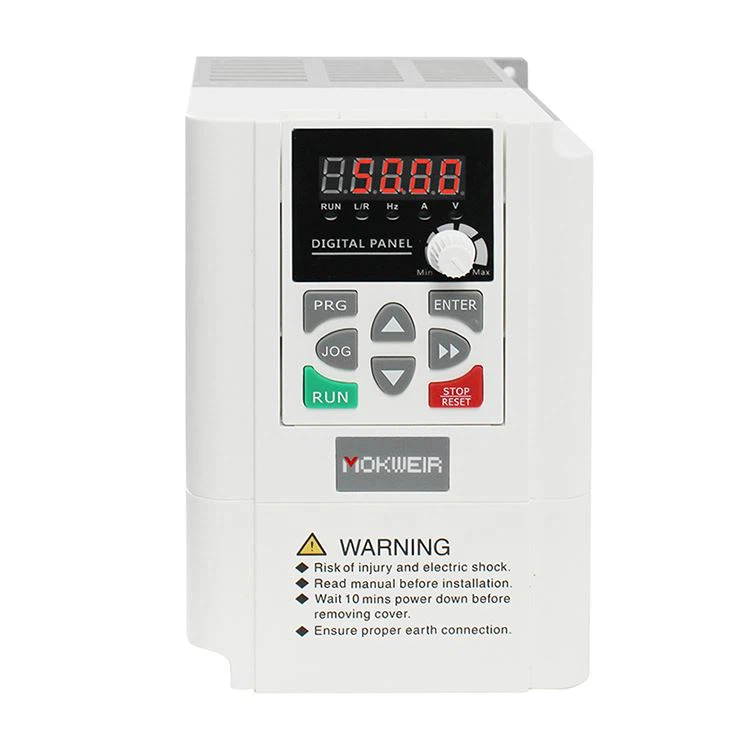
Another cause is an overload on the motor. If the motor is driving a load that is too heavy for its capacity, it will draw more current than normal.
To troubleshoot the over - current error, first, check the motor and wiring for any signs of short - circuits, such as burnt insulation or damaged conductors. Inspect the load connected to the motor to ensure it is within the motor's rated capacity. You may also need to check the VFD's current settings to make sure they are correctly configured.
Over - Temperature Error (OH)
The over - temperature error (OH) shows that the temperature inside the VFD has reached an unsafe level. This error can be caused by several factors.
Poor ventilation is a common cause of over - temperature. If the VFD is installed in a confined space without proper air circulation, the heat generated by the internal components cannot be dissipated effectively.
Another factor is continuous operation at high load. When the VFD is working under a heavy load for a long time, it will generate more heat.
To solve the over - temperature problem, ensure that the VFD has adequate ventilation. You can install fans or ventilation ducts to improve air flow around the drive. Also, check the load on the motor and reduce it if possible to prevent the VFD from overheating.
Ground Fault Error (GF)
A ground fault error (GF) indicates that there is an abnormal current path to the ground. This can be extremely dangerous as it may pose a risk of electric shock.
A damaged motor winding is a common cause of a ground fault. If the insulation of the motor winding breaks down, current can leak to the motor housing and then to the ground.
Faulty wiring can also lead to a ground fault. If the wiring insulation is damaged or there is a loose connection, current may flow to the ground.
When a GF error occurs, immediately shut down the VFD and check the motor and wiring for any signs of damage. Use a megohmmeter to test the insulation resistance of the motor winding. If the insulation resistance is low, the motor may need to be repaired or replaced. Check all the wiring connections and repair or replace any damaged wiring.
Communication Error (CE)
In modern 220v To 380v VFDs, communication functions are often available for remote control and monitoring. A communication error (CE) means that there is a problem with the communication between the VFD and other devices, such as a PLC or a computer.
The communication cable may be the culprit. If the cable is damaged, loose, or not properly connected, the communication signal will be interrupted.
Incorrect communication settings can also cause a CE error. The baud rate, parity, and other communication parameters in the VFD and the connected device must be set to the same values.
To fix the communication error, check the communication cable for damage and ensure it is firmly connected. Verify the communication settings in both the VFD and the connected device and make the necessary adjustments.
Over - Load Error (OL)
The over - load error (OL) shows that the motor is operating under a load that exceeds its rated capacity for an extended period. This can cause the motor and the VFD to overheat and may lead to premature failure.
An improper load selection is a common cause of over - load. If the motor is too small for the application, it will draw more current and experience over - load.
Mechanical problems in the driven equipment can also cause over - load. For example, a jammed conveyor belt or a seized bearing can increase the load on the motor.
To deal with the over - load error, check the load requirements of the application and ensure that the motor and the VFD are properly sized. Inspect the driven equipment for mechanical problems and repair or replace any faulty components.
Motor Over - Temperature Error (MOT)
When the VFD displays a MOT error, it means that the motor temperature has exceeded the safe limit. This error can be caused by factors related to both the motor and the VFD.
On the motor side, poor ventilation can cause over - heating. If the motor's cooling fins are blocked or the cooling fan is not working properly, the motor will not be able to dissipate heat effectively.
On the VFD side, incorrect V/F control settings can lead to motor over - temperature. If the voltage - to - frequency ratio is not set correctly, the motor may draw more current than necessary, generating more heat.
To solve the motor over - temperature problem, clean the motor's cooling fins and check the cooling fan. Adjust the V/F control settings in the VFD to ensure that the motor operates at the optimal voltage - to - frequency ratio.
As a reliable supplier of 220v To 380v VFD, we offer a wide range of high - quality products, including Single Phase Input 3 Phase Output VFD and Single Phase Output VFD. Our VFDs are designed with advanced protection features to minimize the occurrence of these error codes.
If you are facing problems with your VFD or are looking to purchase a new 220v To 380v VFD, feel free to contact us for more information and professional advice. We are committed to providing you with the best solutions and excellent customer service.
References
- "Variable Frequency Drives: Selection, Application, and Troubleshooting" by Thomas H. Liptak
- "Power Electronics: Converters, Applications, and Design" by Ned Mohan, Tore M. Undeland, and William P. Robbins