

Hey there! As a supplier of Single Phase Output VFDs, I often get asked about the speed regulation accuracy of these nifty devices. So, I thought I'd take a deep - dive into this topic and share what I know with you.
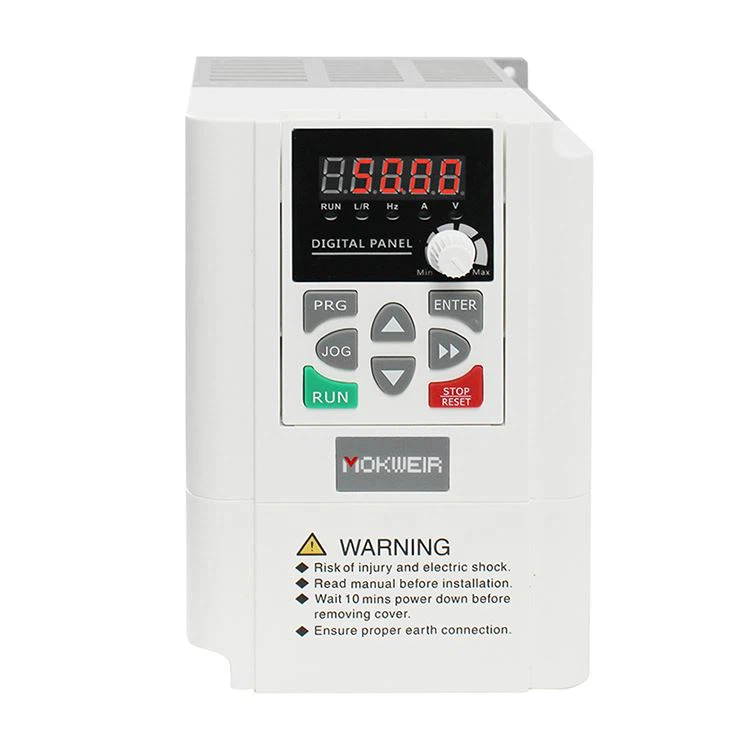

First off, let's quickly understand what a Single Phase Output VFD is. A Single Phase Output VFD, as the name suggests, is a variable frequency drive that provides single - phase output. You can learn more about it on our website Single Phase Output VFD. It's used in a variety of applications where precise control of motor speed is required.
Now, the speed regulation accuracy of a Single Phase Output VFD is a crucial factor. It refers to how precisely the drive can maintain the set speed of the motor under different operating conditions. This accuracy is affected by several factors, and I'll break them down for you.
Factors Affecting Speed Regulation Accuracy
1. Control Algorithm
The control algorithm is like the brain of the VFD. Modern VFDs use advanced algorithms such as vector control. Vector control algorithms can accurately calculate and control the magnetic flux and torque of the motor, which in turn helps in achieving high - precision speed regulation. For example, in a well - designed vector - controlled Single Phase Output VFD, the speed regulation accuracy can be as high as ±0.01% of the set speed. This means that if you set the motor speed to 1000 RPM, the actual speed will be maintained within a very narrow range around 1000 RPM.
2. Feedback System
A feedback system is essential for accurate speed regulation. Most Single Phase Output VFDs use encoders or sensors to provide feedback on the actual motor speed. The VFD compares the actual speed with the set speed and makes adjustments accordingly. For instance, an incremental encoder can provide a high - resolution feedback signal, allowing the VFD to make very fine adjustments to the motor speed. If the feedback system is inaccurate or has a lot of noise, it will directly affect the speed regulation accuracy.
3. Load Characteristics
The nature of the load connected to the motor also plays a big role. Some loads, like constant - torque loads, require the VFD to maintain a stable torque output over a wide speed range. In such cases, the VFD needs to be able to adjust the output voltage and frequency precisely to keep the motor speed constant. On the other hand, variable - torque loads, such as fans and pumps, have different torque requirements at different speeds. A good Single Phase Output VFD should be able to adapt to these load characteristics and still maintain a high level of speed regulation accuracy.
4. Power Supply Quality
The quality of the power supply can't be overlooked. Voltage fluctuations, frequency variations, and harmonics in the power supply can all impact the performance of the VFD. For example, if the input voltage drops suddenly, the VFD may not be able to provide the required output voltage to maintain the motor speed, leading to a decrease in speed regulation accuracy. That's why it's important to have a stable power supply when using a Single Phase Output VFD.
Typical Speed Regulation Accuracy Values
In general, the speed regulation accuracy of a Single Phase Output VFD can vary depending on the model and the application. For basic VFDs, the speed regulation accuracy might be around ±0.5% to ±1% of the set speed. These are usually suitable for applications where a relatively lower level of precision is acceptable, such as some small - scale industrial fans or simple conveyor systems.
However, for high - end Single Phase Output VFDs with advanced control algorithms and high - quality feedback systems, the speed regulation accuracy can be as good as ±0.01% to ±0.1% of the set speed. These are used in applications where extremely precise speed control is required, like in some medical equipment or high - precision manufacturing processes.
Comparison with Other Types of VFDs
Let's compare the speed regulation accuracy of Single Phase Output VFDs with Single Phase Input 3 Phase Output VFD and 220v To 380v VFD.
Single Phase Input 3 Phase Output VFDs are designed to convert single - phase input power to three - phase output power. In terms of speed regulation accuracy, they are generally comparable to Single Phase Output VFDs. However, since they are dealing with three - phase output, they may have more complex control requirements in some cases.
220v To 380v VFDs are mainly focused on voltage conversion while also providing variable frequency control. Their speed regulation accuracy is also in a similar range as Single Phase Output VFDs. The key difference lies in their voltage conversion capabilities, which make them suitable for different applications.
Importance of High - Accuracy Speed Regulation
High - accuracy speed regulation in a Single Phase Output VFD offers several benefits. Firstly, it improves the quality of the end - product in manufacturing processes. For example, in a textile manufacturing plant, precise speed control of the motors driving the spinning machines ensures that the yarn is produced with consistent quality.
Secondly, it can lead to energy savings. When the motor speed is accurately regulated, it operates more efficiently, reducing unnecessary power consumption. This is especially important in applications where the motor runs for long periods, such as in water pumping systems.
Finally, it enhances the reliability and lifespan of the motor. By maintaining a stable speed, the motor is subjected to less stress and wear, which can extend its service life and reduce maintenance costs.
How We Ensure High - Quality Speed Regulation in Our Single Phase Output VFDs
As a supplier, we take several steps to ensure that our Single Phase Output VFDs have high - quality speed regulation. We use the latest control algorithms in our products. Our R & D team is constantly working on improving these algorithms to adapt to different load characteristics and operating conditions.
We also use high - quality feedback sensors in our VFDs. These sensors are carefully calibrated to provide accurate speed feedback, allowing the VFD to make precise adjustments.
In addition, we conduct rigorous testing on our products. Before they leave the factory, each VFD undergoes a series of tests to ensure that it meets our strict quality standards for speed regulation accuracy.
Contact Us for Your Single Phase Output VFD Needs
If you're in the market for a Single Phase Output VFD with high - speed regulation accuracy, we'd love to hear from you. Whether you're working on a small - scale project or a large - scale industrial application, we have the right VFD for you. Reach out to us to start a conversation about your specific requirements and let's find the perfect solution together.
References
- "Variable Frequency Drives: Principles, Operation, and Application" by Thomas H. Lipo
- "Motor Control and Electrical Vehicle Applications" by Bimal K. Bose